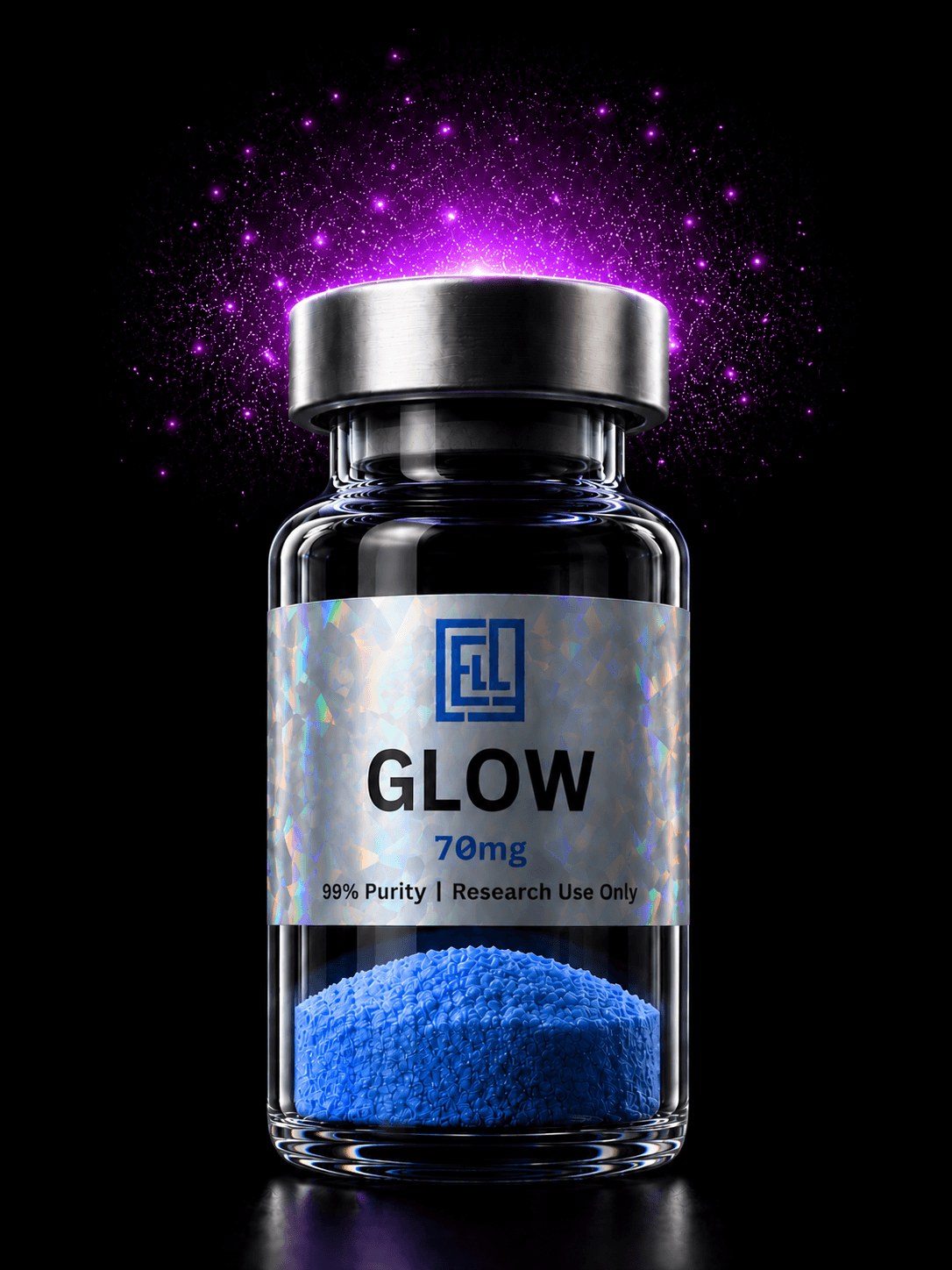
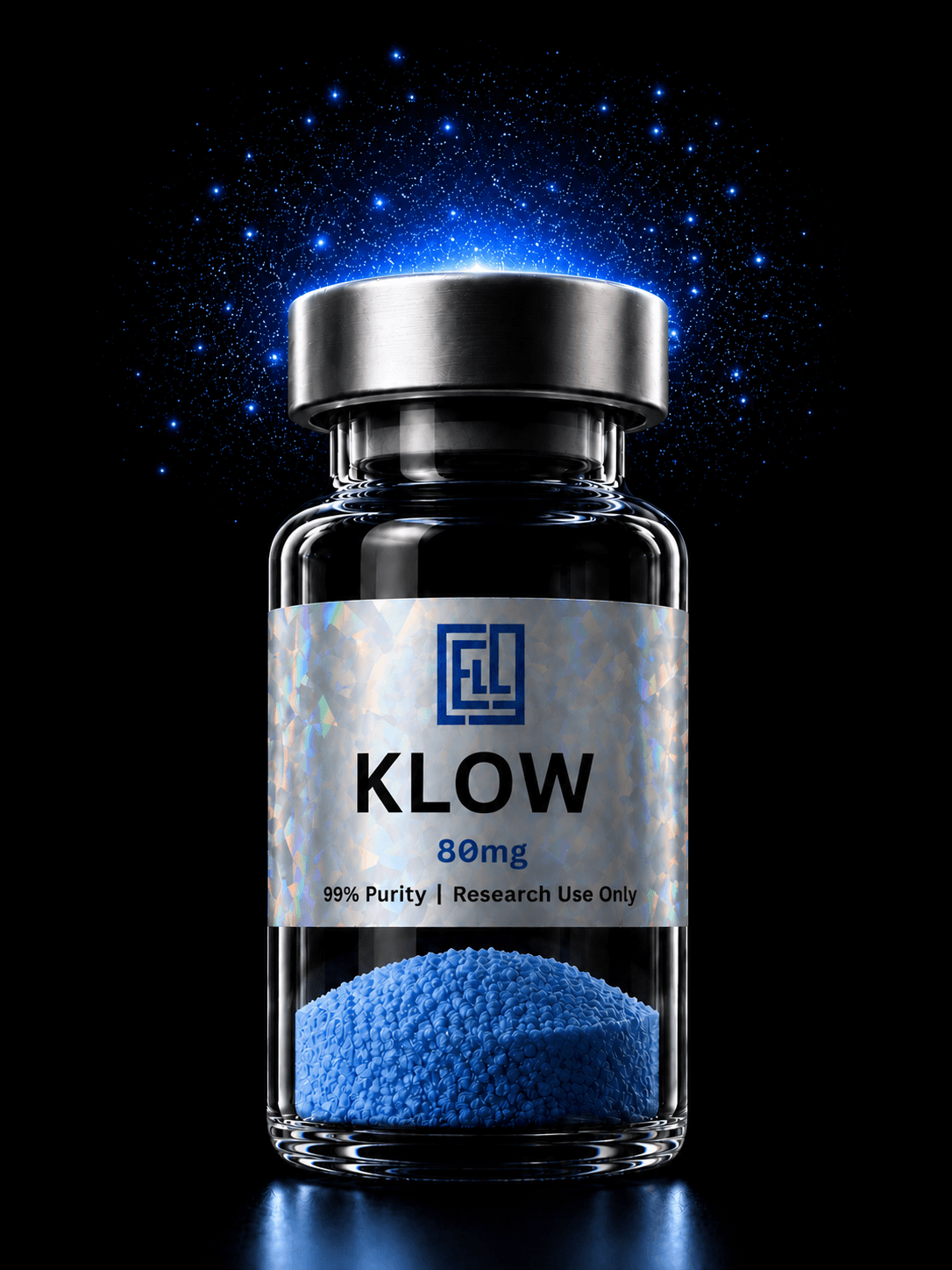
Compound
Peptide Blends — GLOW & KLOW Research Overview
4 min read · Updated 2026-07-31
GLOW and KLOW are multi-peptide research blends that combine three individually studied peptides in a single preparation. This overview covers what they are, from a research perspective.
What the blends are
Both GLOW and KLOW are research-formulated blends of the same three peptides — BPC-157, TB-500 and GHK-Cu — presented together in a single lyophilised vial. They differ in total peptide mass per vial (GLOW 70 mg, KLOW 80 mg). Each is supplied with an independently published Certificate of Analysis.
Combining peptides in one preparation lets researchers study complementary pathways without reconstituting and handling three separate vials.
Why blends are studied
The three component peptides are each the subject of established preclinical literature:
- BPC-157 — connective-tissue repair and angiogenesis research (overview)
- TB-500 — cell migration and tissue-repair research (overview)
- GHK-Cu — dermal and extracellular-matrix research (overview)
Together they are studied in models of connective-tissue repair, cellular signalling, and regenerative research pathways — the rationale being potential complementary interactions between compounds acting on related pathways.
These describe research contexts only, not efficacy claims. Neither blend is approved for therapeutic use, and neither is supplied for human or animal consumption.
Physical & handling properties
- Format: lyophilised powder (three-peptide blend)
- Reconstitution: dissolve gently in bacteriostatic water to a clear solution; use the concentration calculator to record the total-peptide concentration
- Storage: refrigerate lyophilised and reconstituted vials (storage guide)
Verifying a blend
A blend's Certificate of Analysis is especially important — you want confirmation that all three peptides are present at the stated purity, not a single peptide sold as a blend. Every East Coast Labs batch is independently tested and published before listing, verifiable by batch number. See How to Read a COA.
Supplied strictly for laboratory research use only. Not for human or animal consumption. We do not provide dosing or administration guidance.